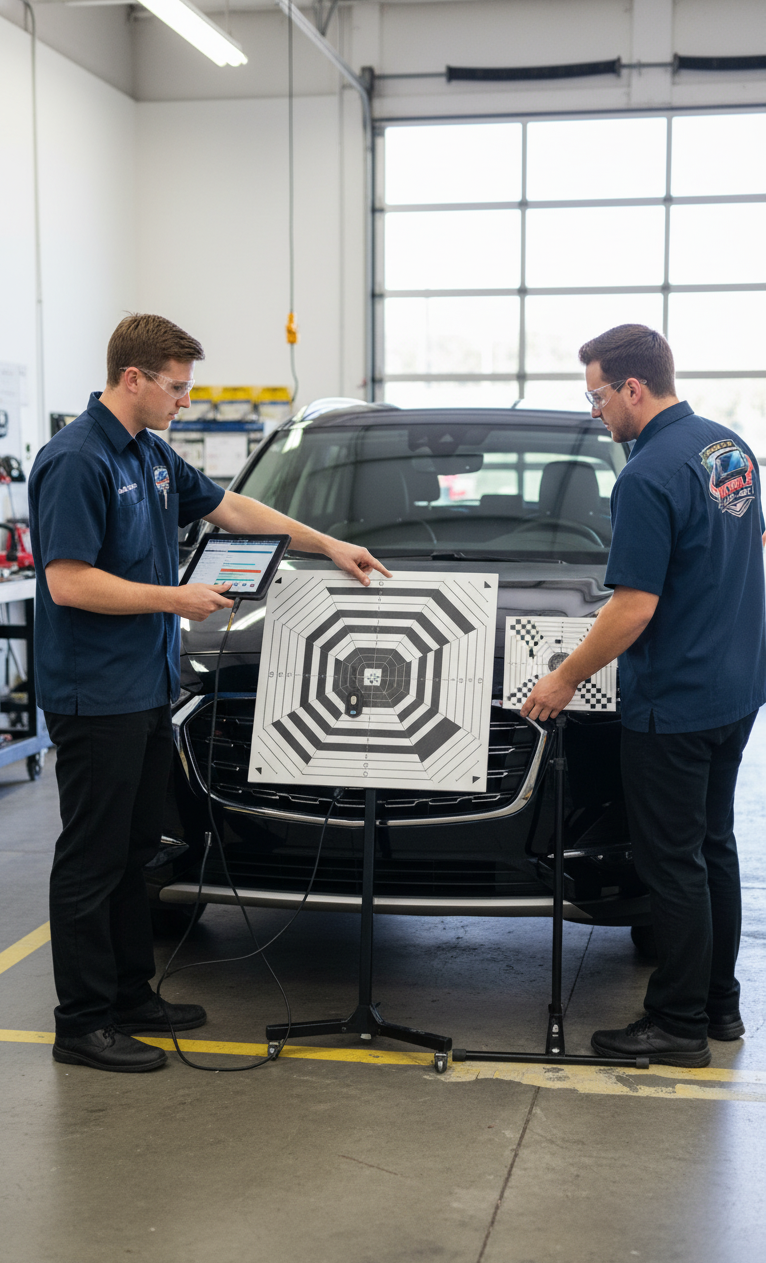
Manufacturer required ADAS recalibration with verification, documentation, and service options based on your vehicle's required method.
ADAS calibration is a professional recalibration service that restores the accuracy of your vehicle’s Advanced Driver Assistance Systems after windshield replacement or other work that can affect camera or sensor alignment.
San Gabriel Valley Mobile Auto Glass provides ADAS recalibration, including windshield camera calibration, using the calibration method your vehicle requires, then verifies results with a post scan and provides documentation.
ADAS calibration aligns the forward facing camera and other ADAS sensors, such as radar, so safety systems interpret the road correctly. Even a small change in camera positioning, sensor aim, or mounting geometry can affect how ADAS features detect lane markings, vehicles, and distance.
The correct calibration method depends on the vehicle's manufacturer specification.
Performed indoors with calibration targets placed at precise positions around the vehicle. Requires a controlled environment and specific floor space to achieve accurate target placement. Used when the manufacturer specification requires static method.
Performed by driving the vehicle on public roads at a set speed, often on roads with clear lane markings. The calibration system uses the camera's live input to recalibrate during the drive. Used when the manufacturer specification requires dynamic method.
Some vehicles require both static and dynamic steps. We follow the method your vehicle requires. Vehicle make, model, year, and trim are used to confirm the required calibration method before the appointment.
Calibration as a defined service with clear verification and documentation so you know exactly what was completed.
ADAS calibration is not a generic add on. We focus on calibration as a defined service with clear verification and documentation so you know what was completed.
We perform a pre scan to confirm system status and the required calibration method, then a post scan to verify completion and confirm results.
Some vehicles require static calibration, some require dynamic, and some require both. We confirm the correct method for your vehicle before the service begins.
We support the calibration approach your vehicle needs, including controlled condition requirements for static calibration and manufacturer specified driving criteria for dynamic calibration.
Many calibrations can be scheduled with mobile convenience depending on your vehicle, system type, and required method. If controlled conditions are required, we set expectations before the appointment.
Designed around service deliverables: verification, calibration performed to manufacturer requirements, and documentation.
We begin with a diagnostic scan to check for fault codes and confirm the ADAS configuration. This step determines the required calibration method based on the vehicle's systems and manufacturer requirements.
We perform the ADAS calibration method your vehicle requires — static calibration, dynamic calibration, or static plus dynamic — using required equipment and procedures aligned with manufacturer specifications.
After calibration, we complete a post scan to verify results and confirm system status. You receive documentation that records the calibration and verification outcome.
Mobile ADAS calibration eligibility depends on the required calibration method. We confirm requirements before scheduling so expectations are clear.
A flat, controlled indoor space is needed for accurate target placement. Mobile static calibration requires suitable conditions at the service location.
If conditions are not met, the vehicle may need to be serviced at a facility with the correct setup.
Dynamic calibration can often be performed as a mobile service if road conditions allow.
For combination methods, eligibility for mobile service depends on whether static requirements can be met at the location.
Share your vehicle details and location when booking. We will confirm whether mobile service is available for your calibration type.
ADAS calibration pricing and timing are vehicle-specific. We provide a quote and time estimate when booking.
We provide a time estimate when booking.
Share your vehicle details and confirm whether you need standalone calibration or calibration as part of windshield replacement. We will confirm method, pricing, and availability.
Common questions about ADAS calibration requirements, timing, cost, and mobile eligibility.
ADAS calibration is the process of recalibrating your vehicle's Advanced Driver Assistance System cameras and sensors to manufacturer specifications after work that may have affected their position or alignment.
Calibration is often required after windshield replacement, collision repair, sensor replacement, suspension work, or any service that affects camera or sensor mounting.
Static calibration uses targets placed around the vehicle in a controlled environment. Dynamic calibration is performed by driving at set conditions. The required method depends on the vehicle.
It depends on the required method. Dynamic calibration can often be performed as a mobile service. Static calibration requires specific indoor conditions and space.
Time depends on the method. Static calibration includes setup and target placement. Dynamic includes a drive cycle. Combination methods take longer. We provide a time estimate during booking.
Many modern vehicles with forward-facing cameras require calibration after windshield replacement. Vehicle year, make, model, and trim determine the requirement.
Pricing depends on the vehicle, required calibration method, and whether calibration is part of a windshield replacement or a standalone service.
Yes. We provide documentation for the calibration performed, including the post scan results.
If you need ADAS recalibration after windshield replacement or safety system work, we can quote and schedule the correct service for your vehicle. Share the year, make, model, and the work that was performed.